Showing posts with label Subtraction. Show all posts

Wednesday, June 1, 2016

Subtraction Time!

During the third grade intervention group we really worked on subtraction.  I used games, number talks, and paper pencil practice (some kids actually love to just sit and work on a worksheet) to help solidify their subtraction facts so they could be fluent with them. 

This game is called, "Find the Difference".  It is from 
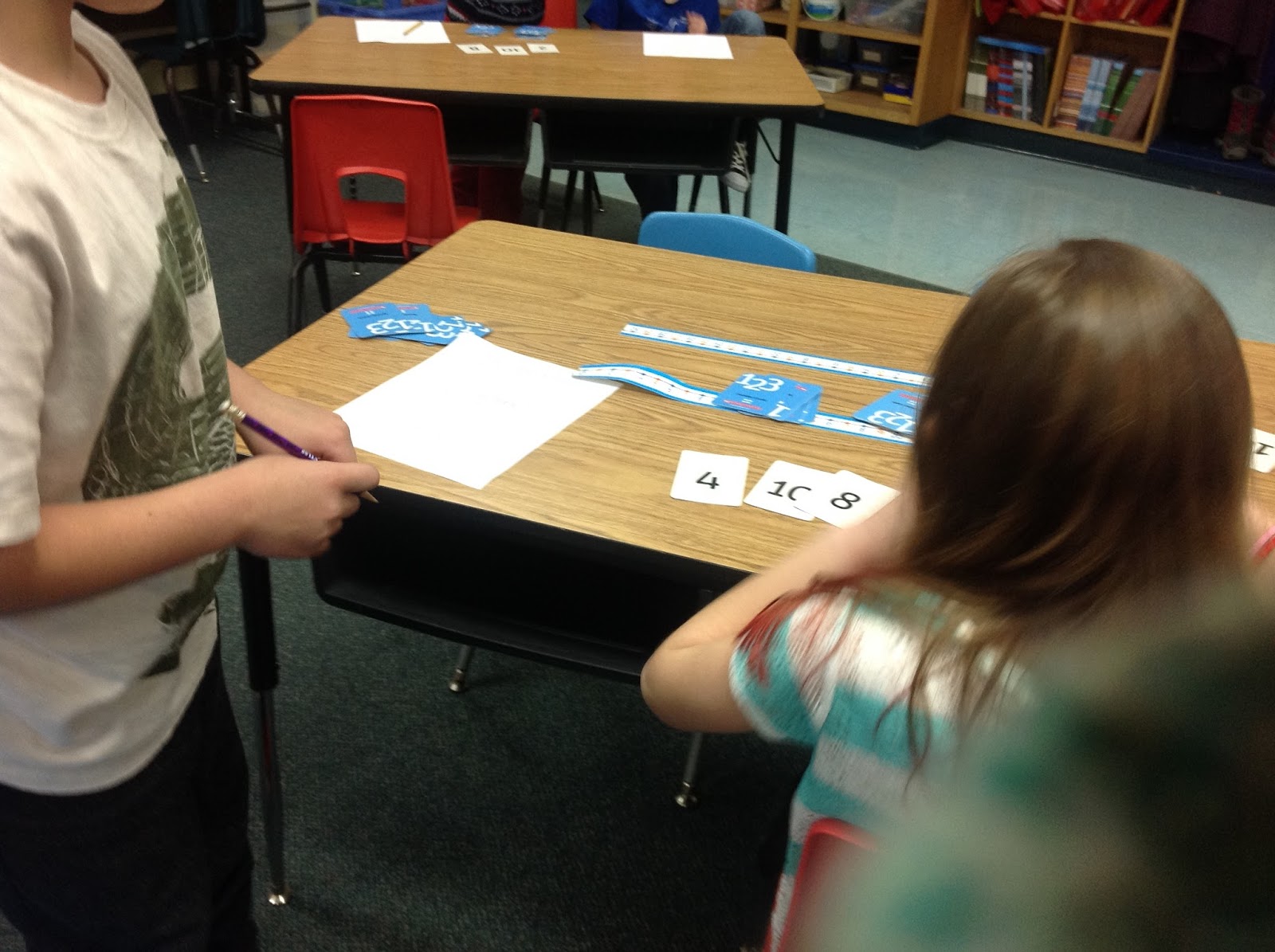
In this game you put out three rows of three cards and roll a die.  You keep the rest of the cards in a stack face down.  You roll a die and look for two cards in the rows that have a difference that equals your number.

You take out those two cards and replace them with the face down stack.  The person who collects the most cards in the end is the winner of this game.  Sometimes my students do not like to play winning and losing games so if they decide they don't want a winning or losing game, they just play together taking out the cards that they see and when they have collected all the cards they can, they start a new round.  I tell them each time that even if they are playing a winning/losing game, the actual goal is always to be practicing, thinking, and doing math.

Monday, May 30, 2016

Subtraction Pyramid

I have found that my students love puzzles.  So...why not combine subtraction practice with a puzzle.  Luckily I found this Brain Bender Subtraction Puzzle online.  It was probably one of the many things I have pinned from Pinterest.  For this puzzle, students had to match up the subtraction equations with their answers.  One triangle had equations and another had answers.

When it was put together it made a large triangle.  We found out that there is more than one solution to make the large triangle work.  Students had to figure out the subtraction problem and also figure out how to make it work to form a large triangle and complete the puzzle.  This allowed for A LOT of great conversations!

Friday, May 13, 2016

Back and Forth to 100 in 6 rolls

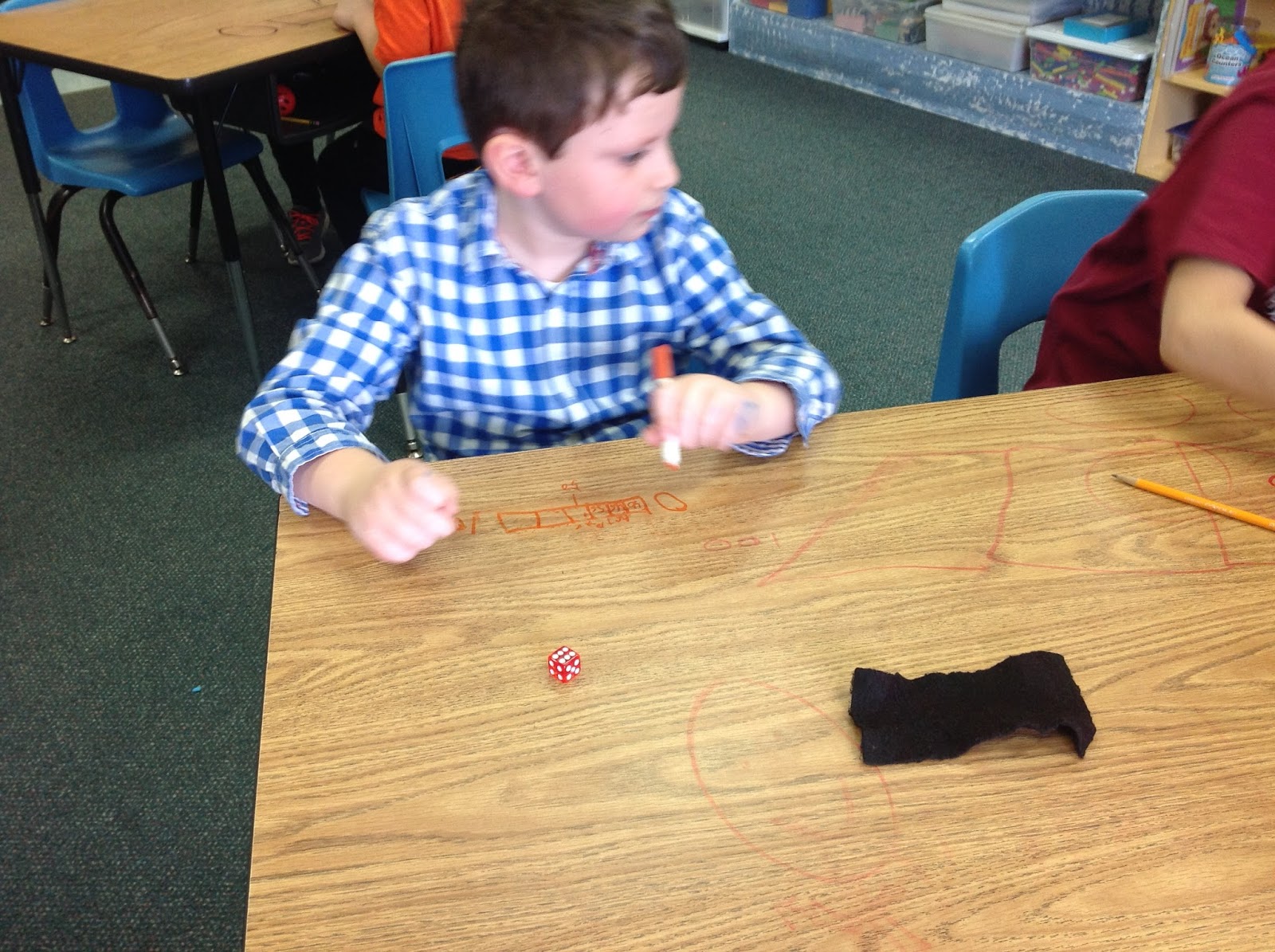
In my third grade intervention group we are practicing subtraction.  In this game the students needed to roll a die and decide whether to use it in the ones place or the tens place.  They only had six rolls and they couldn't go over 100.
                                         
They also played this with subtracting a ten or a one.  When subtracting they started at 100 and rolled the die and also decided whether to use it in the ones or tens place.  
Again they only had six rolls to do this in.  In either version they had to get as close to 0 or 100 as they could.  Then they would calculate the difference and that would be their score.
At the end of the round, the person with the lowest score was the winner.


This is a great game that includes problem solving, place value, addition, and subtraction.  For an added bonus I let them write it out on their tables which makes any game that much more fun and engaging.  The markers wipe off with a wet paper towel or a disinfectant wipe but the excitement it brings when they find out they can write on the tables is well worth any clean up.

Friday, May 6, 2016

Third Grade Back and Forth to 100 in 6 rolls.

More Fraction Fun!

During the fourth grade intervention group, I used Marilyn Burns' Do the Math Fractions A.  This program offers a lot of hands-on games to help develop fractional thinking and skills.

Students play, Cover Up, where they use their fraction pieces to cover a whole.  This really allows them to SEE the fractions within each other.  This will help when they compare and compute fractions.  
They also played games called, Uncover 1 and Uncover 2.  In these games they started out putting a combination of different fractions to equal 1 whole and then they rolled a die and took off that amount. 


They had a choice sometimes of exchanging fractional pieces for other fractions equaling the same amount.
Games are such a great way to help develop understanding.  Sometimes the students don't realize that the game is actually helping them learn the math.  We often have discussions on how the game or games relate to what we are learning or focusing on.  We also talk about how the games relate to other concepts.

Monday, May 2, 2016

Take Away From the Teens

Subtraction can be difficult for some students to master.  I find each year that I need to do a subtraction focus intervention group.  The good thing about this (other than the math itself) is that there are a lot of games that can be used for subtraction practice.

 
This game is called Teen Take Away.  In this game you put a card with the number 10 in the middle and make a deck of 1-5 and another of 6-9.  Put the 1-5 card with the ten to make your teen number and then subtraction the 6-9 card.  You could extend this to use larger numbers also.

It's a great way to also talk about how addition is related to subtraction.  Ask questions such as, "How could you turn this into an addition problem?"  I like to have them just play the game first and then add in a recording sheet.  You can also use a recording sheet that has them write both an addition and subtraction equation and then have a discussion on them.

This game could also be played with dice.  So many choices to practice subtraction!

Monday, April 4, 2016

Fractions are Fun! Really!!!

Fourth Graders are expected to extend understanding of fraction equivalence and order.  Marilyn Burns' Do the Math-Fractions-A is a great program to help with this.   

The whole program consists of hands-on, visual manipulatives of fractions.  Students play games and visualize the fractional parts within one another.  We talk about mixed numbers, improper fractions, and different ways we can represent equivalent fractions.  
The students look forward to coming in each day.  I even had one of the fourth grade teachers tell me that one of our students was upset when he thought our group was going to end early one day.
Through games, the students build fractions, take apart fractions, and compare fractions.  We also work on adding and subtracting fractions.  It is all visual though and it is amazing how the students can really see the fractional parts within other fractions.  Plus they are just excited to be here and working with fractions.  Having students focused and engaged, it just doesn't get better than that!